
Breast implant exchange
“Doctor, should I have my implants removed or replaced?”
It’s one of the questions I hear most. And it almost never comes alone: it comes with worries about where the scars will be, how the shape and size will turn out, and how much recovery will hurt. This page isn’t written to talk you into surgery. It’s written so you arrive at the consultation knowing what to ask me.
- At ten years, it’s time to check them, not to have surgery.
- The first step is an ultrasound to see what condition they’re in.
- Replacing and removing are both real options. You don’t have to be sick.
Tell me which implants you have and since when, and I'll tell you what we need to look at.
Dr. Saad or his team will reply. No commitment.
What an implant exchange is
Removing the implants you have and placing new ones in the same operation. The new ones can be the same size, a little larger, or smaller. That’s decided in the consultation.
The starting point is simple: an implant is a synthetic product, and like any synthetic product, its materials wear over time. That’s why manufacturers of every brand recommend considering a replacement from ten years on.
That isn’t an expiration date or a referral to the operating room. It’s the time to take a look. And for me, taking a look means something specific: a breast ultrasound that tells me what condition the implant is in and how the surrounding tissue is doing. It’s noninvasive, and it’s what turns a hunch —“I’ve had these for so many years”— into a fact.
An exchange isn’t always just an exchange, either. Depending on the case, it can go together with a breast lift, when the breast has dropped as well as lost volume; or it can be solved by working on the pocket that holds the implant, without replacing it.
Breast ultrasound
What condition the implant is in and how the tissue is doing.
Replace
A new one: same size, larger, or smaller.
Remove
And rebuild the shape with your own tissue.
You don't have to be sick.
Replace or remove: both are real options
This is where I can really help you.
Many patients come in thinking that if they have their implants removed, they’ll be left flat. It’s a reasonable thing to ask — and out of that fear, some agree to a replacement they may not have wanted.
I’ve spent years developing a technique to rebuild the breast with your own tissue after the implant comes out. In practice, that means removal is no longer a leap into the unknown: in my practice, replacing and removing are two options we compare side by side, not a default and a consolation prize.
And the first step isn’t surgery: the first step is a consultation to look at your case.
If you've had them for years and don't know where to start, start by telling me which ones you have.
Tell me about your implants What happens if you don't replace them →
And you don’t have to be sick
It’s the first thing I tell anyone thinking about having them removed: you don’t need to be ill, or to have a breast condition, to make that decision.
The reverse is true too: no condition makes the decision automatic. When patients ask me whether ASIA syndrome means they have to have their implants removed, my answer is that every case is different. For some patients, removing them and rebuilding the breast is the right call; for others, we need to consider their age, what they want aesthetically and functionally, the sports they play, their lifestyle, and whether they want more children.
Be wary of anyone who gives you a one-size-fits-all answer without having examined you.
-
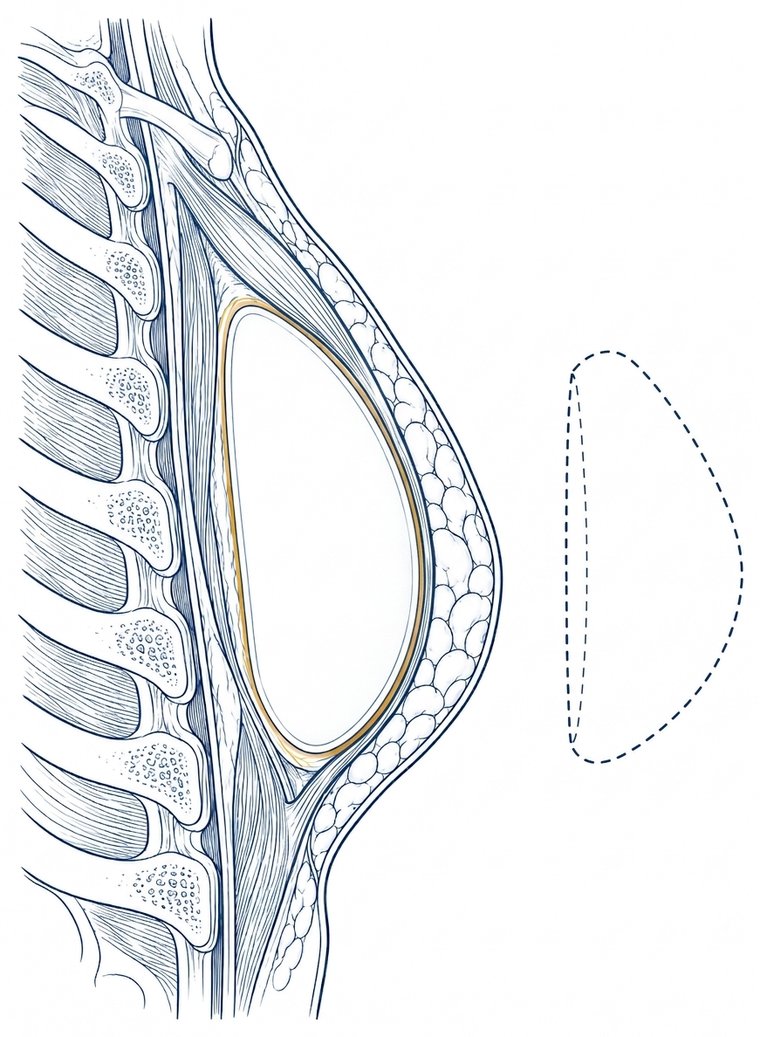
The implant with its capsule (in gold), behind the pectoral muscle. On the right, the new implant, with its flat base toward the ribs.
How I choose the new implant
Not just by size. The two mistakes I see most often in consultation are worrying only about cup size and comparing yourself to a friend.
Besides size, I choose the shape, consistency, and projection, and I match them to your weight, your height, and the shape of your chest. And I look at you from the side, to see the proportion between your breasts, your buttocks, and your waist.
When I can, I avoid new incisions in the skin
I’ve corrected a breast revision —a patient whose lower breast had dropped under the weight of the implant— by reshaping the pocket and the muscle from the inside, with no new incisions in the skin. Along the same lines, I use pocket closure to adjust the implant’s position and improve symmetry.
It doesn’t work in every case. But it reflects a preference: before touching the skin, I work on the structure. It’s the same approach I take with a first breast augmentation.
Where I operate
I see you for consultations in my office in Cali, and I operate in a clinic. I don’t do any procedure in my office, not even a minor one: it’s for consultations, so I can explain everything calmly before you decide.
I operate in a fourth-level clinic —the highest level of care in Colombia’s health system— with full medical services: inpatient care, emergency, and intensive care. The operating room is certified by the regional Health Department.
I also operate in Pereira, in a clinic of the same level.
What this procedure doesn't do
I can’t guarantee the final size or appearance. It doesn’t depend only on the implant: it depends on your breast tissue, which changes with your weight and your hormones.
Your two sides aren’t identical, and they never will be.
You will have a scar, and you’ll only see how it has settled after a year. I choose where it goes and how I close it. How it finally looks depends on your skin and your collagen — that’s something you’re born with and inherit, and it doesn’t depend on the technique or the suture material. If you smoke, it will be worse.
Ten years isn’t an alarm. It’s a manufacturer’s recommendation, and in practice, I translate it into an ultrasound, not an operating room.
And part of the result isn’t up to me. It takes time to settle, it depends on the two of us working together, and it also depends on your diet and exercise.
And what adverse events can occur
I’m telling you before you sit down with me, not after, and calmly.
From the new implant. The body forms a capsule of tissue around it again.
The body forms a capsule of tissue around it again. In some cases it hardens and squeezes the implant, causing discomfort or pain: that’s capsular contracture, and it can be corrected with surgery. And in a very small percentage of cases, the body doesn’t tolerate the material and the implant has to be removed.
From the recovery. There may be bruising from bleeding, fluid buildup (seromas), milk collecting inside the breast, or an infection, on the skin or around the implant.
There may be bruising from bleeding, fluid buildup (seromas), milk collecting inside the breast, or an infection, on the skin or around the implant. If that happens, you may need one or more additional surgeries, medical treatment, or both.
From life afterward. A hard blow to the chest can rupture an implant and cause a hematoma or an infection; in that case the area has to be repaired and the damaged implant removed or replaced.
A hard blow to the chest can rupture an implant and cause a hematoma or an infection; in that case the area has to be repaired and the damaged implant removed or replaced.
And the risks of any surgery , which are uncommon: bleeding from clotting problems; changes in blood flow to the skin, which can damage the areola, the nipple, or another part of the breast; allergies or reactions to medications or materials; complications from anesthesia; blood clots that travel to the lungs; and, in very rare cases, heart or lung complications that can be life-threatening.
Which are uncommon: bleeding from clotting problems; changes in blood flow to the skin, which can damage the areola, the nipple, or another part of the breast; allergies or reactions to medications or materials; complications from anesthesia; blood clots that travel to the lungs; and, in very rare cases, heart or lung complications that can be life-threatening.
Every surgery, big or small, carries risks. That’s why you sign for them before you go in, and that’s why I’m telling you about them beforehand.
If any of this is holding you back, that's exactly what we should talk about before you decide.
Alternatives and related procedures
- Breast explant surgery — having them removed without replacing them, rebuilding shape and volume with your own tissue. It’s the other half of the question this page opens with.
- Breast augmentation and lift — if you’re looking for a first augmentation, or if the main problem is sagging rather than volume.
- Tummy tuck — often combined with breast surgery in the same plan.
- Who Dr. Saad Barhoum is — training, certification, and registration, so you can check them.
How to prepare
- 1 · The consultation.
This is where we answer the underlying question: replace or remove. I go over your history, how long you’ve had your current implants, and what brought you in. It’s the time to ask me about scars, shape and size, and pain — the three worries I hear most.
- 2 · A breast ultrasound.
If you’ve had your implants for more than ten years, this is what I’ll ask for: to know what condition the implant is in, and at the same time how the tissue is doing. It’s noninvasive.
- 3 · Medical history and lab tests
Before going into the operating room.
- 4 · The checking that’s up to you.
Verify my training, my specialist certification, and my registration. In Colombia, plastic surgery is a medical specialty of at least four years, with a degree recognized by the Ministry of Education and registration in RETHUS, the national registry of health professionals.
What I need you to tell me
To assess you safely and recommend the best option for your case, I need to know all of your information:
- Previous surgeries, including implants or earlier procedures.
- Medications — everything you’re taking, including vitamins and supplements.
- Medical history: illnesses, allergies, or significant conditions.
- Tests and medical records. If you have previous results, bring them to the consultation.
When it comes to your health, no information is too small.
- You don’t need to know which surgery you need. That’s my job.
What does help is arriving knowing what bothers you and what you’d like to achieve: that’s how I understand your expectations and explain the options in your case.
Ask me everything —the procedure, the risks, recovery time, the results you can expect. There are no silly questions. If you’re an adult, you can bring someone with you to the consultation, though you don’t have to. If you’re a minor, you must come with a trusted companion.
Surgery shouldn’t be an impulse decision. Take all the time you need.
Getting back to your life
- Follow-up visits.
The first at 4 days, the second at 8, and stitch removal at 15. If any stitches remain, we continue weekly.
- The first few days.
My anesthesiologist specializes in pain management and also takes part in your recovery. Breast surgery doesn’t require post-op lymphatic drainage massages to bring down the swelling.
- The first 20 days.
No driving. With a breast lift, I add about 15 days off work and, if you’re coming from another city, no traveling until the 20 days are up.
- The first month.
In breast surgery after implant removal, about 70% of the swelling has gone down at one month and the pain is moderate.
- Up to three months.
The bra I recommend. No strain and no heavy lifting. Sun and weights from three months on.
- And the third act is yours.
The instructions, your diet, hydration, prescriptions, and follow-up visits.
Frequently asked questions
How often do they need to be replaced? Manufacturers recommend considering a replacement from ten years on.
Manufacturers recommend considering a replacement from ten years on. When you reach that point, what I recommend in practice is a breast ultrasound to see what condition they’re in. Ideally, have them checked every ten years.
Should I replace them or remove them? Both options are real.
Both options are real. They can be replaced with the same size, larger, or smaller; or they can be removed permanently and the breast reshaped with your own tissue. Which one suits you is something we decide with the ultrasound in front of us.
Do I have to be sick to have them removed? No.
No.
Will I have new scars? A scar is unavoidable whenever the skin is cut.
A scar is unavoidable whenever the skin is cut. But there are cases I correct without new incisions, by reshaping the pocket and the muscle from the inside. Whether yours is one of them is something we’ll see in the consultation.
How is the new implant chosen? Shape, consistency, and projection as well as size, matched to your weight, your height, and your chest, and looking at you from the side as well.
Shape, consistency, and projection as well as size, matched to your weight, your height, and your chest, and looking at you from the side as well.
How do I know if an implant has ruptured? Most ruptures cause no symptoms.
Most ruptures cause no symptoms. That’s why the check is done with ultrasound: it’s inexpensive, noninvasive, involves no radiation, and performs about as well as an MRI.
Why are implants replaced? Because the ultrasound shows damage, or because you want a different size.
Because the ultrasound shows damage, or because you want a different size. Mild capsular contracture, if the implants are less than 6 months old, can be resolved without replacing them.
Are more women having their implants removed? Yes.
Yes. Over the last five years, the number of women who want their implants removed has risen by up to 47%, whether because of problems or by their own choice. That’s what I told my colleagues, and it’s the figure I publish.
If you're traveling in for surgery
Having surgery in Cali doesn’t change the operation, but it does change the planning.
If you’re coming from out of town: a recommended minimum of 15 days in the city. If the exchange includes a breast lift, the minimum is 20 days. It’s a minimum: if you can stay longer, even better. Once that time is up, you can fly home.
Flights, paperwork, where to stay while you recover, remote follow-up, and what happens if something comes up once you’re back home: Your journey.
The next step
If you’ve had your implants for years and don’t know whether it’s time to replace them, remove them, or simply have them checked, write to me and tell me about it. My first answer won’t be a surgery date.
The information on this page is educational and does not replace an in-person medical consultation. No result is guaranteed: what can be achieved in your case, and its risks, are discussed in consultation and set out in the informed consent form you sign before surgery.