
Tummy tuck
There’s a kind of belly that won’t go away with diet or the gym.
Not because you’re not trying hard enough, but because what’s left isn’t fat anymore: it’s stretched skin and separated muscle, and you can’t train those away. It’s a conversation I have again and again in consultation with women who’ve had children or lost a lot of weight. They’ve done everything they’re supposed to do, and their abdomen still looks the same.
- It’s surgery of the abdominal wall, not of fat.
- If your abdominal muscles are separated, no amount of sit-ups will close the gap.
- It’s not for losing weight, and the stretch marks higher up stay.
Tell me about your case and I'll tell you whether there's a diastasis or hernia to look at.
Dr. Saad or his team will reply. No commitment.
What it really does
A tummy tuck (abdominoplasty) is surgery of the abdominal wall. It isn’t surgery of fat.
Pregnancies, childbirth, and big weight changes affect three things: stretch marks, loose skin, and loose muscles. This surgery addresses all three at once, in the same operation:
- I separate the skin from the muscle.
- I stitch the rectus abdominis muscles back together —this is called plication— so the abdomen ends up flat and the waist more defined.
- I remove the extra skin, which is exactly where the stretch marks are concentrated.
- I reposition the belly button on the newly tightened skin.
Step two is the one almost nobody understands before the consultation. After a pregnancy, the two rectus muscles can be left separated —this is diastasis recti. While they’re separated, no exercise can bring them back together, because the problem isn’t strength: it’s position. The stitches put them back where they belong.
The stretch marks that go away are the ones on the skin I remove. The ones higher up stay.
-
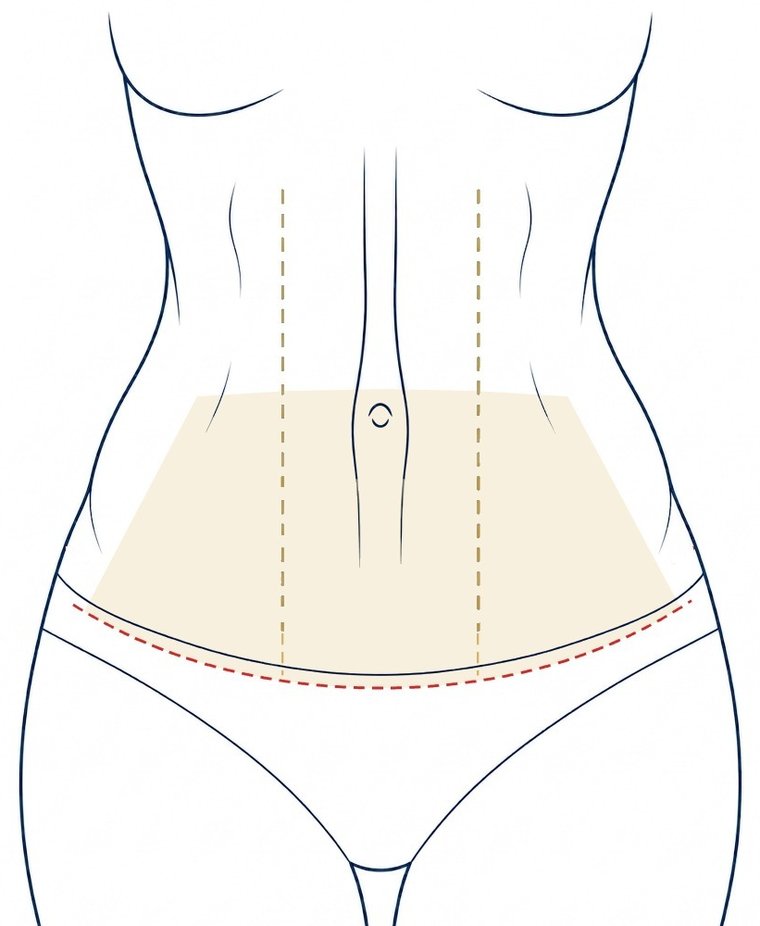
The incision (red) sits below the top edge of your underwear. The skin I remove (beige) goes from there up to the navel. The gold lines are the muscle repair.
What I do before operating: an ultrasound of the abdominal wall
It’s not a formality. It’s a noninvasive test I do in the operating room, before starting surgery, to see what’s under the skin.
It tells me two things that change the surgery: whether there’s a hernia above or below the belly button that needs to be repaired in the same operation, and how much muscle separation has to be closed. That’s how I plan the repair.
Put another way: finding a hernia with a scalpel in my hand isn’t the same as going in knowing it’s there. We do all of this for our patients’ safety.
Do you have a hernia, diastasis, or you're not sure? That shows up on the ultrasound before anything is decided.
Tell me about your case How I work on the rest of your contour →
- And I always work with the same team.
My anesthesiologist is my brother, Dr. Salim, who I’ve operated with since 2003, and we have staff who specialize in post-op lymphatic drainage. When I talk about pain management, I’m not talking about a protocol: I’m talking about a specific person who’s in the operating room and who’s there afterward too.
The stretch marks higher up stay.
Where I operate
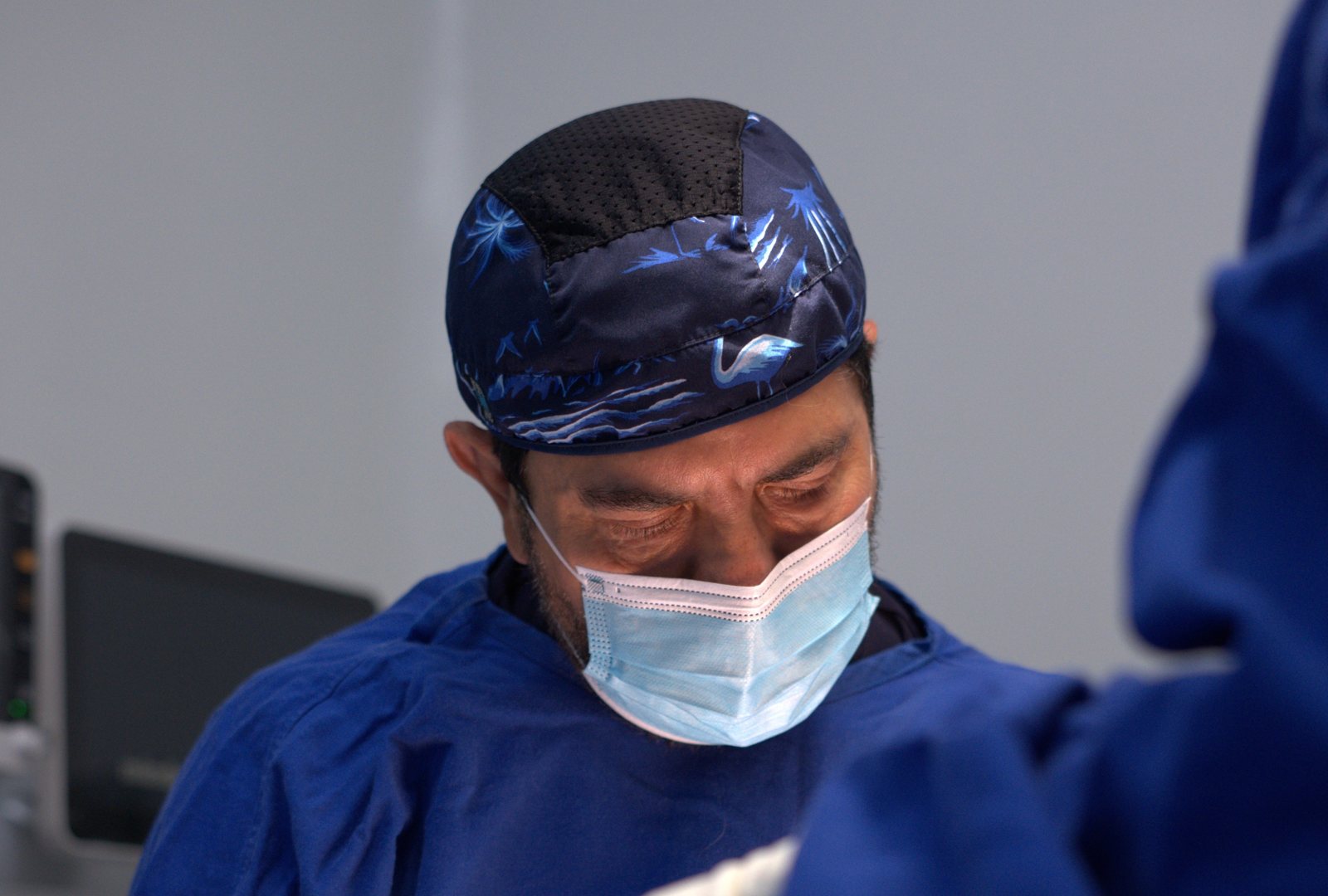
I see you for consultations in my office in Cali, and I operate in a clinic. I don’t do any procedure in my office, not even a minor one: it’s for consultations, so I can explain everything calmly before you decide.
I operate in a fourth-level clinic —the highest level of care in Colombia’s health system— with full medical services: inpatient care, emergency, and intensive care. The operating room is certified by the regional Health Department.
I also operate in Pereira, in a clinic of the same level.
What this surgery doesn't do
It’s not for losing weight. None of the three problems it fixes —extra skin, stretch marks, separated muscles— is excess weight. If your goal is to lose weight, the operating room isn’t the tool.
It doesn’t remove localized fat. That’s a different surgery, and I often do both in the same operation: liposculpture and a tummy tuck.
It doesn’t erase the stretch marks higher up. Only the ones on the skin I remove go away.
And you will have a scar. Always. A scar is unavoidable whenever the skin is cut. What does depend on me is where I place it and how I close it so it heals as a fine line. The rest —your genetics, your diet, your habits, smoking above all— is out of my hands. If you smoke, your scar will be worse, and no technique can fix that.
The fear you bring is the usual one. About 98% of my patients arrive afraid, and not of the surgery itself: of the scar, the pain, and the anesthesia.
And I can’t guarantee an exact result. Plastic surgery, like medicine in general, is a commitment to the care provided, not to a guaranteed result. Healing and how your body changes afterward are individual processes shaped by genetic, hormonal, nutritional, and lifestyle factors the surgeon doesn’t control.
And what adverse events can occur
All of this is in the consent form you’ll sign. I’m telling you here so you can read it calmly at home and arrive at the consultation knowing what to ask.
What’s specific to this surgery. The most common problems are fluid buildup under the skin —a seroma— and bruising.
The most common problems are fluid buildup under the skin —a seroma— and bruising. There can be healing problems, especially where the tension is greatest, and in some cases skin loss. Sensation around the scar and the belly button can change and take months to come back, or not come back completely. And the scar is long and permanent.
What applies to any surgery. Bleeding that may require a transfusion, infection, reactions to medications and anesthesia, and blood clots that travel to the lungs, which in abdominal surgery deserve to be named on their own.
Bleeding that may require a transfusion, infection, reactions to medications and anesthesia, and blood clots that travel to the lungs, which in abdominal surgery deserve to be named on their own. They’re uncommon, but some can be serious and even life-threatening.
If you smoke , the risk of healing problems and skin loss goes up.
The risk of healing problems and skin loss goes up.
If there’s a complication. You may need another surgery, a hospital stay, or medical treatment, and those costs are paid by the patient: in Colombia, public health insurance doesn’t cover cosmetic surgery or its complications.
You may need another surgery, a hospital stay, or medical treatment, and those costs are paid by the patient: in Colombia, public health insurance doesn’t cover cosmetic surgery or its complications. That’s why there are specific insurance policies that cover up to 30 days after surgery.
If any of this worries you, that's exactly what we should talk about before you decide — not after.
Alternatives and related procedures
- Liposculpture and fat transfer — if what you have too much of is fat and the skin still has good tone, it’s a different procedure. The two are often done in the same surgery.
- Buttocks — the fat I remove here is the fat that’s transferred there.
- Breast explant surgery and breast augmentation — the breasts are the other half of the change after pregnancies.
- About Dr. Saad Barhoum — training, certification, and registration.
How to prepare
- 1 · The consultation.
We talk, go over your medical history and your lab tests, and discuss expectations and risks. The consultation isn’t there to tell you yes: it’s there to know what’s reasonable to expect in your case and what would make me advise against it.
- 2 · The abdominal wall ultrasound.
Specific to this surgery, and it’s what I described above.
- 3 · Lab tests
To make sure everything is in order.
What I need you to tell me
To assess you safely and recommend the best option for your case, I need to know all of your information:
- Previous surgeries, including implants or earlier procedures.
- Medications — everything you’re taking, including vitamins and supplements.
- Medical history: illnesses, allergies, or significant conditions.
- Tests and medical records. If you have previous results, bring them to the consultation.
When it comes to your health, no information is too small.
- You don’t need to know which surgery you need. That’s my job.
What does help is arriving knowing what bothers you and what you’d like to achieve: that’s how I understand your expectations and explain the options in your case.
Ask me everything —the procedure, the risks, recovery time, the results you can expect. There are no silly questions. If you’re an adult, you can bring someone with you to the consultation, though you don’t have to. If you’re a minor, you must come with a trusted companion.
Surgery shouldn’t be an impulse decision. Take all the time you need.
Getting back to your life
- These timelines are for this surgery, and only this one.
What I can tell you today: cosmetic surgery is planned surgery, and recovery has to be planned too — a clean, suitable place to stay, someone to be with you, a balanced diet, plenty of fluids, and following prescriptions and follow-up visits. Pain is managed by an anesthesiologist on my team, during and after surgery. And swelling is managed by draining fluid with a needle every other day until you travel.
- Follow-up visits.
The first at 4 days, the second at 8, and stitch removal at 15. If any stitches remain, we continue weekly.
Frequently asked questions
Will I be left with a very visible scar? You’ll be left with a scar: that’s unavoidable.
You’ll be left with a scar: that’s unavoidable. My job is to place it where it will be as discreet as possible and close it so it heals as a fine line. After that, your genetics, your diet, and your habits play a part.
Does it hurt a lot? Fear of pain is natural, and my answer isn’t a promise: it’s the team.
Fear of pain is natural, and my answer isn’t a promise: it’s the team. There’s an anesthesiologist dedicated to pain management during surgery and also during recovery, step by step.
How do I know the person operating on me is qualified? In Colombia, plastic surgery is a medical specialty of at least four years, completed at universities and teaching hospitals, with certification from the Ministry of Education and registration in RETHUS, the national registry of health professionals.
In Colombia, plastic surgery is a medical specialty of at least four years, completed at universities and teaching hospitals, with certification from the Ministry of Education and registration in RETHUS, the national registry of health professionals. In my case: my specialty training at the Pontifical Catholic University of São Paulo —six years in total—, certification in Colombia, and registration in RETHUS. You can check this before writing to me or to anyone else.
If you're traveling from outside Colombia
Having surgery abroad changes the logistics, not the medicine. What changes is how long you need to stay, who sees you once you’re back home, and when you can get on a plane.
If you’re coming from out of town: a minimum of 20 days in the city. If we combine it with liposculpture, the minimum is longer, and I’ll confirm it in the consultation. It’s a minimum: if you can stay longer, even better.
Once that time is up you can fly, and we decide the date together at your last follow-up visit, along with instructions for the trip.
The next step
Before surgery there’s a consultation, and the first step isn’t surgery: it’s looking at your case. If you want to know whether a tummy tuck is what you need —or whether your issue is fat rather than skin, or the other way around— write to me and we’ll look at it.
The information on this page is educational and does not replace an in-person medical consultation. No result is guaranteed: what can be achieved in your case, and its risks, are discussed in consultation and set out in the informed consent form you sign before surgery.