
Breast explant surgery · reconstruction with the Closed Fist technique
“If I take them out, will I be left flat?”
It’s the first question almost every woman asks. And it’s a fair one: the implant took up space for years, and when it comes out, that space is still there. My answer is not to give you another, smaller implant. It’s to use your own tissue —the tissue you already have— to restore shape and volume to the breast in the same surgery in which I remove the implant. You won’t look the way you did before implants. Or the way you did with them. You’ll have your own breasts.
- I remove the implants and rebuild with your own tissue, in the same surgery.
- You won’t be left flat-chested.
- Wanting them out is reason enough.
Tell me about your case and I'll tell you what can be rebuilt with your own tissue.
Dr. Saad or his team will reply. No commitment.
Why more and more women are having their implants removed
Demand for permanent implant removal has risen 47% in five years.
I see four reasons in my practice, and not all of them are medical: personal preference, pain, breast implant illness, and concern about ASIA syndrome.
“Although this syndrome is not very specific, it has alarmed some patients, mainly on social media.”
I’ll tell you what I tell other surgeons: fear sells surgery, too. If we operate, I want it to be because it’s the right decision for you, not because you’re afraid.
And to be precise, because it matters: more than fifty years of research have not shown that implant material causes cancer in breast tissue. What has been described in the last decade is a very low incidence of a lymphoma in the capsule of some women with implants, and a syndrome of nonspecific symptoms that has been linked to the presence of any foreign material in the body: that is ASIA.
My list of indications, exactly as I presented it to colleagues, separates the objective reasons —grade III/IV capsular contracture or malposition, implant rupture, breast implant illness, ASIA syndrome, other autoimmune diseases, breast implant–associated anaplastic large cell lymphoma (BIA-ALCL), squamous cell carcinoma— from the subjective ones: your own request and nonspecific symptoms.
Objective indications
- Grade III–IV capsular contracture, or malposition
- Implant rupture
- Breast implant illness (BII)
- ASIA syndrome
- Other autoimmune diseases
- Anaplastic large cell lymphoma (BIA-ALCL)
- Squamous cell carcinoma
Subjective indications
- The patient's own request
- Nonspecific symptoms
The problem, stated plainly
There are more than three hundred techniques described since 1800. None of them, on its own, solves in a single operation everything an explant leaves behind.
Because there are two problems at once:
The volume the implant used to fill. Once it’s removed, the breast is left empty.
The sagging. The original tissue has thinned and stretched over the years the implant was there.
Solving only one of the two is what leads to a second surgery. I solve both in the same operation: the volume, with the Closed Fist technique; the sagging, with an inverted-T breast lift. That is what makes this technique different.
How I do it: open your hand, then close it
Hold your hand out flat and look at it from the side: it’s flat, a couple of centimeters thick. Now make a fist. The same hand, with nothing added, now has height and volume.
When I remove an implant, the tissue left behind is flat, much like that open hand. What I do is fold that tissue over on itself —close the fist inside the breast— and secure it at three points so it stays there.
Folded this way, the flap becomes four times taller: from the two to three centimeters it measures laid flat (about an inch) to eight to twelve once folded (roughly 3 to 5 inches).
- First point, at the top.
I anchor the first point to the upper portion of the pectoralis major muscle. This is what fills the upper part of the breast, the area that empties the most when the implant comes out.
- Second point, in the center.
I close the breast from the sides, just below the areola. This is what gives it back its conical shape instead of leaving it wide and sagging.
- Third point, at the bottom.
I secure the lower edge and recreate the crease beneath the breast, which is what holds the shape over the years.
The tissue folds over on itself and is secured at three points
- 1At the top Fills the upper part of the breast, the area that empties the most when the implant comes out.
- 2In the center Closes the breast from the sides below the areola and gives it back its conical shape.
- 3At the bottom Recreates the crease beneath the breast, which holds the shape over the years.
-
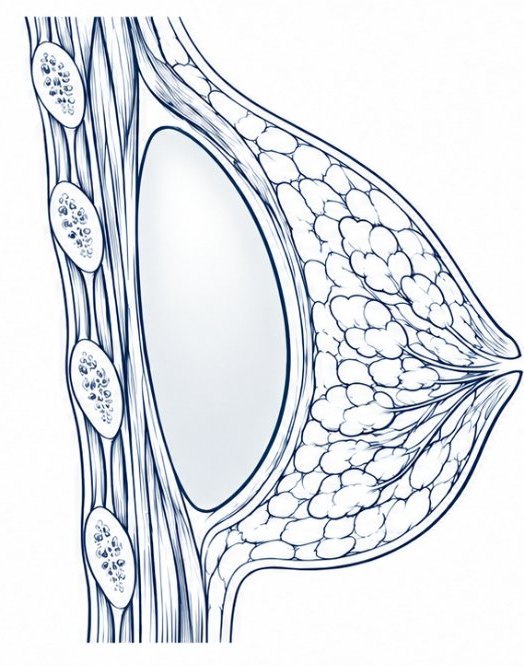
1 Before: the breast with the implant.
-
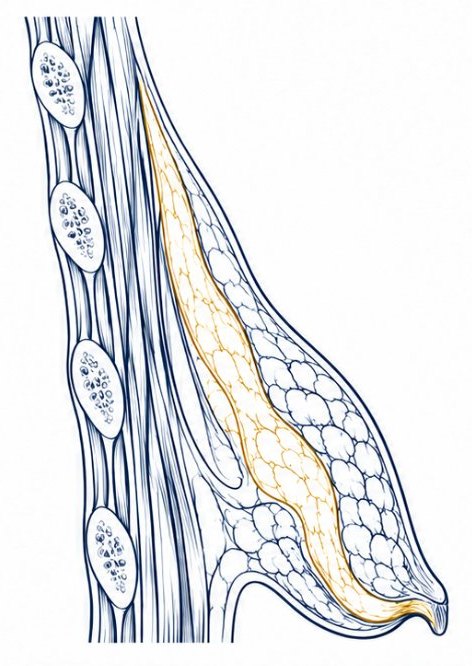
2 When the implant comes out, the breast is left empty and sagging. In gold, the tissue of your own that I'm going to use.
-
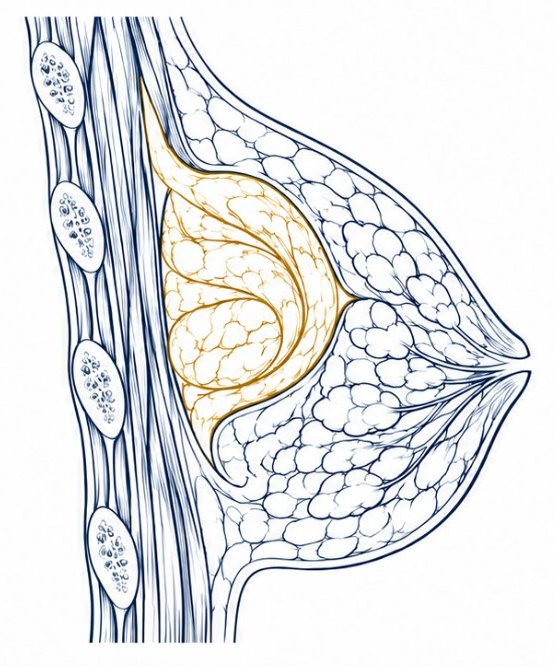
3 I rotate that tissue and fold it like a fist: it fills the breast and lifts it again.
Two more things you should know
And when needed, I add a graft of your own fat to the flap, taken from another part of your body, to refine the shape. Even then, nothing goes in that isn’t yours.
And the capsule — this one matters. The body forms a capsule around every implant. Some surgeons leave it in if it “looks fine.” I always remove it, and I always send it for analysis. There aren’t two paths depending on what I see in the operating room: there is only one.
In medical terms, in case you want to compare notes with your own surgeon Triangular dermo-fatty and glandular flap on a superomedial pedicle, folded 120° inward and upward and fixed to the muscle fascia between the 3rd and 4th intercostal spaces; second anchor between the breast pillars at the lower border of the areola; third at the base of the pyramid, creating the new inframammary fold. Capsulectomy with biopsy in every case. Closure with a Wise pattern. In Spanish I call it “Plicatura en Puño” — a mixed autologous surgical technique; in English, the Closed Fist Surgical Technique. The official name of the procedure on the consent form is permanent explantation and reconstruction of breast shape with mastopexy, by local flap rotation and fat transfer.
Have implants and not sure whether this is for you? Send me your case and I'll tell you what I see.
Where I operate
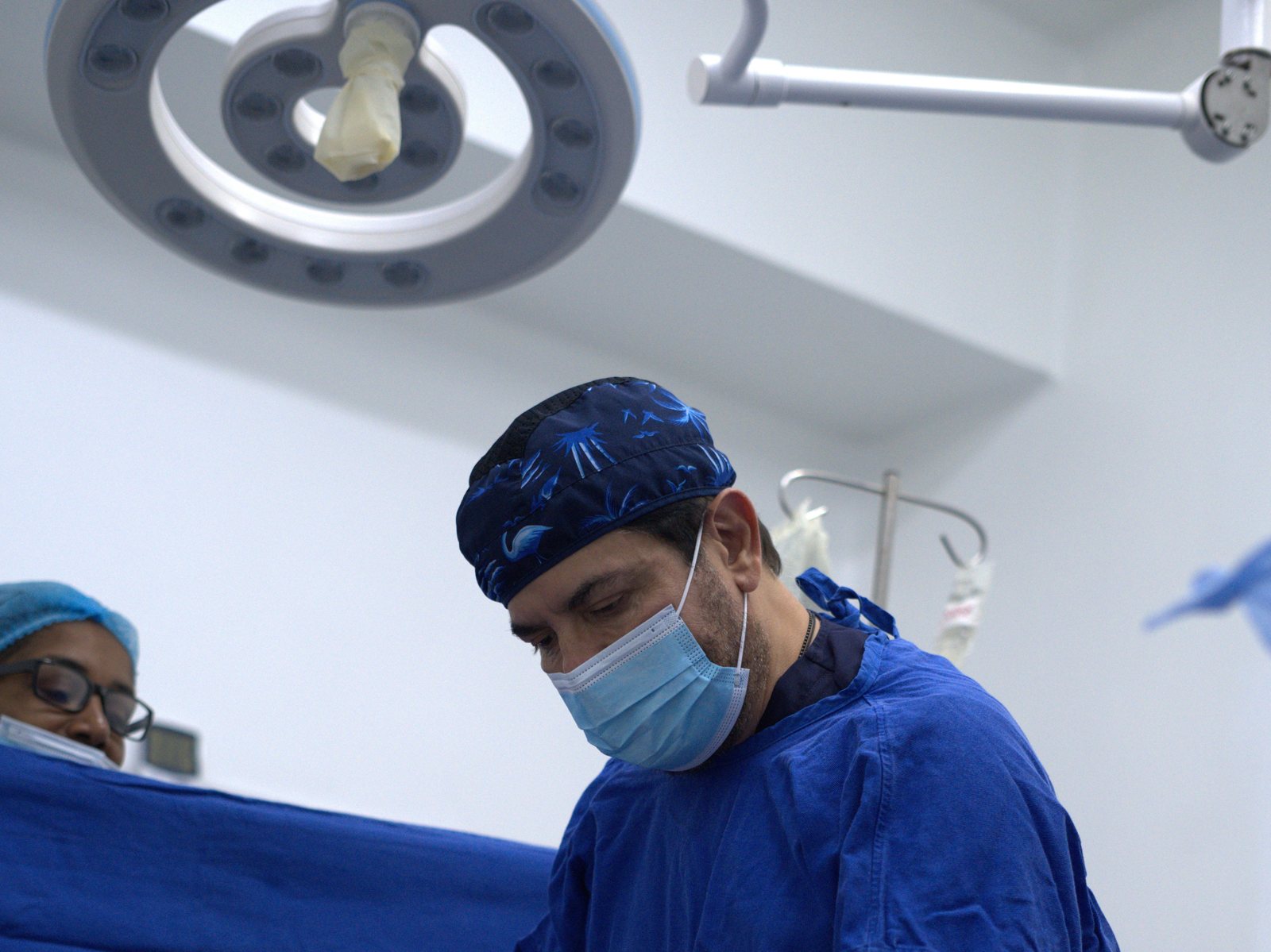
I see you for consultations in my office in Cali, and I operate in a clinic. I don’t do any procedure in my office, not even a minor one: it’s for consultations, so I can explain everything calmly before you decide.
I operate in a fourth-level clinic —the highest level of care in Colombia’s health system— with full medical services: inpatient care, emergency, and intensive care. The operating room is certified by the regional Health Department.
The surgical unit where I operate has been licensed and listed in REPS, Colombia’s national registry of health providers, since 2006, with its own sterilization center and pharmacy service.
I also operate in Pereira, in a clinic of the same level.
What to expect, step by step
- The day.
The surgery takes about three and a half hours, under general or epidural anesthesia, and it’s outpatient: you go home the same day. If we combine it with liposuction, you stay in the hospital for 24 hours.
- The first week.
You’ll have a drain: a thin tube that removes the fluid that builds up. It’s more of a nuisance than it is painful. You won’t be able to lift anything with your arms or drive.
- Pain.
It’s concentrated in the first three days and it’s moderate: regular pain relievers take care of it. It hurts less than when your implants were put in. If needed, there’s a pain pump for those three days.
- At home.
You can shower the next day. You sleep semi-upright, on two or three pillows, for at least 15 days. You wear the compression bra for 3 months.
- Follow-up visits.
The first at 4 days, the second at 8, and stitch removal at 15. If any stitches remain, we continue weekly.
- If you’re traveling in for surgery: a recommended minimum of 20 days in the city.
This isn’t travel advice, it’s part of the procedure: I need that time for your rest, for you to follow the instructions, and for the scheduled post-op checkups. It’s written in the consent form you’ll sign. It’s a minimum: if you can stay longer, even better. Once that time is up, you can fly home.
The scar
This technique closes with a Wise pattern: a scar around the areola and a straight line down to the crease beneath the breast, the same as in a breast lift, and it stays hidden under any bra or bikini. In every case the scar is shaped like an inverted T.
How it heals doesn’t depend only on me. It depends on your skin, your diet, and whether you smoke. In most people it heals well. In a few it stays visible. We know this before surgery, and we talk about it in the consultation.
And what adverse events can occur
Everything below is in the consent form you’ll sign. I’m telling you here so you can read it calmly at home and arrive at the consultation knowing what to ask.
What’s specific to this surgery When the flap is rotated, blood flow to the skin can be compromised.
When the flap is rotated, blood flow to the skin can be compromised. If that happens, part of the areola or nipple may not heal well and may even be lost. It isn’t common, but it’s the risk most specific to this technique, and that’s why I want you to know about it.
The fat I graft sometimes doesn’t fully take, or it forms small cysts or lumps; less often, an abscess. This happens in a very small percentage of cases and, if it does, an additional procedure may be needed to correct it.
And what can happen in any breast surgery: bleeding or bruising, fluid buildup, milk discharge, and infection, on the skin or deeper inside.
What applies to any surgery As with any surgery under anesthesia, there are uncommon risks: allergies or reactions to medications, complications from anesthesia, blood clots that travel to the lungs, fat embolism, or an infection that spreads.
As with any surgery under anesthesia, there are uncommon risks: allergies or reactions to medications, complications from anesthesia, blood clots that travel to the lungs, fat embolism, or an infection that spreads. They’re rare, but some can be serious and even life-threatening. No surgery is free of them, and I’d rather you hear it from me.
If there’s a complication. You may need another surgery, or several, or medical treatment.
You may need another surgery, or several, or medical treatment. It’s worth knowing ahead of time: in Colombia, neither public health insurance nor private prepaid plans cover cosmetic surgery or its complications. That’s why there are specific insurance policies that cover up to 30 days after surgery, and clinics won’t operate without one.
What I can’t guarantee. The final size and shape, because they don’t depend only on me: they depend on your tissue, your weight, and your hormones.
The final size and shape, because they don’t depend only on me: they depend on your tissue, your weight, and your hormones. And the scar: you’ll only see how it has settled after a year, and that depends on the collagen you were born with, not on the technique or the suture.
“Medicine and surgery are not exact sciences, and no responsible professional can guarantee a result. The two sides of the human body are not the same, and they never can be.” — from my informed consent form (translated from Spanish)
If any of this worries you, that's exactly what we should talk about before you decide — not after.
How to prepare
- The consultation.
We go through your history: what implants you have, since when, who operated on you, and what has happened since. And we talk about expectations, which in this surgery is the part that matters most — because what you’re getting back is your own breast, not the one you had with implants.
- Lab tests
To make sure everything is in order before the procedure.
What I need you to tell me
To assess you safely and recommend the best option for your case, I need to know all of your information:
- Previous surgeries, including implants or earlier procedures.
- Medications — everything you’re taking, including vitamins and supplements.
- Medical history: illnesses, allergies, or significant conditions.
- Tests and medical records. If you have previous results, bring them to the consultation.
When it comes to your health, no information is too small.
- You don’t need to know which surgery you need. That’s my job.
What does help is arriving knowing what bothers you and what you’d like to achieve: that’s how I understand your expectations and explain the options in your case.
Ask me everything —the procedure, the risks, recovery time, the results you can expect. There are no silly questions. If you’re an adult, you can bring someone with you to the consultation, though you don’t have to. If you’re a minor, you must come with a trusted companion.
Surgery shouldn’t be an impulse decision. Take all the time you need.
Getting back to your life
- These timelines are for this surgery, not any other.
First 3 days This is when it hurts the most, and it’s moderate pain. Regular pain medication. First 10 days Drain in place. No strain on your arms. No driving. Day 14 Back to work. Until day 20 Still no driving, no jumping, no heavy lifting. At one month The scars are closing. A bit more activity allowed. At 3 months Gym with weights. Sleeping on your stomach. Sun exposure. Between months 4 and 6 The swelling is completely gone. This is the final result, not what you see in the first week. “This recovery is very calm, with little pain. […] Removing the implants hurts less than putting them in.” — Dr. Saad Barhoum, audio recorded September 4 (translated from Spanish)
Frequently asked questions
How long is the recovery? Ten days with the drain and no strain, back to work on day 14, and the final result between the fourth and sixth month.
Ten days with the drain and no strain, back to work on day 14, and the final result between the fourth and sixth month.
How many days until I can drive? From day 20.
From day 20. No car or motorcycle before then.
When can I be out in the sun? From the third month on.
From the third month on.
How long do I need to stay in Cali? The recommended minimum is 20 days, for rest, the instructions, and the follow-up visits.
The recommended minimum is 20 days, for rest, the instructions, and the follow-up visits.
Will I go back to the size I was before implants? Approximately.
Approximately. It may end up somewhat smaller, because the tissue thins during the years the implant was in place.
Do you also remove the capsule? It depends on its condition.
It depends on its condition. If it’s healthy, I remove part of it; if there are signs of disease, I remove it completely. What I don’t do is remove all of it when it’s stuck to the ribs: there the risk is a pneumothorax (a collapsed lung), and it isn’t worth it.
How long do I wear the compression bra? Three months.
Three months.
When can I have sex again? One month after surgery.
One month after surgery.
The information on this page is educational and does not replace an in-person medical consultation. No result is guaranteed: what can be achieved in your case, and its risks, are discussed in consultation and set out in the informed consent form you sign before surgery.