Facelift
A facelift doesn’t change your face: it repositions the tissues that have dropped over the years, naturally and harmoniously, so you’re still you.
- It repositions, it doesn’t pull: the goal is for your face to go back to where it was without losing your expression.
- It’s often combined with other facial procedures: blepharoplasty and chin liposuction.
- It’s decided by seeing you: what has dropped and what makes sense in your case.
Tell me what you see that's different in your face and I'll tell you what can be done.
Dr. Saad or his team will reply. No commitment.
What it is
It’s the surgery that repositions the tissues of the face. Every detail counts when it comes to preserving your expression.
In some cases I combine three techniques in the same surgery —blepharoplasty, chin liposuction, and facelift— to rejuvenate the face in a balanced way, respecting its structure and its natural expression.
Depending on what I see in your face, the facelift can be partial —upper, middle, or lower third— or full, with the deep plane technique. It isn’t just about removing the skin that’s left over with the years: I reposition the muscles of the face and neck. That’s why the effect lasts for years: it reverses the aging process.
Where the scars go depends on each case: the incisions run along the edge of the scalp and around the ear, in front and behind.
-
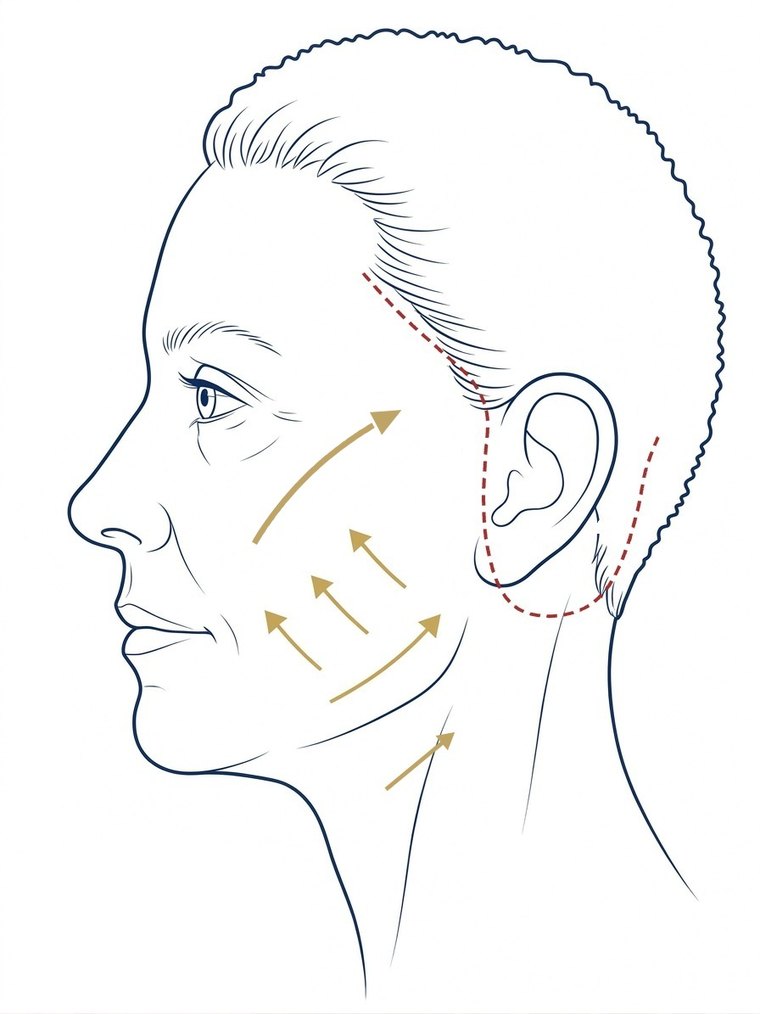
The incisions, in dashed red: along the edge of the scalp and around the ear, in front and behind. The arrows: the direction in which I reposition the muscles of the face and neck.
Where I operate
I see you for consultations in my office in Cali, and I operate in a clinic. I don’t do any procedure in my office, not even a minor one: it’s for consultations, so I can explain everything calmly before you decide.
- I operate in a fourth-level clinic
—the highest level of care in Colombia’s health system— with full medical services: inpatient care, emergency, and intensive care. The operating room is certified by the regional Health Department.
I also operate in Pereira, in a clinic of the same level.
What this surgery doesn't do
- It doesn’t have an exact duration. It lasts for years, but how many depends on each person: it’s tied to your habits, your genetics, your diet, and exercise.
- It doesn’t improve skin texture. For that it can be complemented with laser or another type of facial peel, three months after surgery.
Who I recommend it for: mainly, from age 45, people who have lost a lot of weight and have excess skin and loose facial muscles; and from age 50, people with signs of aging.
And what adverse events can occur
All of this is in the consent form you’ll sign. I’m telling you here, calmly and at home, because a decision like this isn’t made with a sheet of paper in your hand ten minutes before going into the operating room.
What’s specific to this surgery
Bleeding and hematoma. It’s the most common complication of a facelift: blood can collect under the skin, and it may need to be drained or require another operation.
It’s the most common complication of a facelift: blood can collect under the skin, and it may need to be drained or require another operation. Uncontrolled high blood pressure increases the risk.
The facial nerves. There may be weakness or asymmetry in some movements of the face.
There may be weakness or asymmetry in some movements of the face. It’s usually temporary and improves over weeks or months; in rare cases it can be permanent.
Sensation. It’s common to feel less in the cheeks, the neck, and the area around the ears.
It’s common to feel less in the cheeks, the neck, and the area around the ears. It usually improves with time.
Scars and hair. A scar can end up wider, redder, or thicker than expected and need treatment.
A scar can end up wider, redder, or thicker than expected and need treatment. Near the incisions in the scalp some hair can fall out, and the hairline or the sideburns can change.
Fluid, swelling, and bruising. Fluid can collect under the skin and need draining.
Fluid can collect under the skin and need draining. Swelling and bruising can last several weeks, and skin color can change for a while.
And, in rare cases, skin damage from poor blood supply —more likely in smokers—, contour irregularities, or a change in the shape of the earlobe, which may need other procedures.
from poor blood supply —more likely in smokers—, contour irregularities, or a change in the shape of the earlobe, which may need other procedures.
What applies to any surgery Infection (it’s uncommon and is treated with antibiotics or, sometimes, with another surgery), allergies or reactions to medications and anesthesia, clotting problems, and blood clots that travel to the lungs.
Infection (it’s uncommon and is treated with antibiotics or, sometimes, with another surgery), allergies or reactions to medications and anesthesia, clotting problems, and blood clots that travel to the lungs. They’re uncommon, but some can be serious and even life-threatening.
If something gets complicated. Treatment may require a hospital stay and lengthen your recovery and your return to work.
Treatment may require a hospital stay and lengthen your recovery and your return to work. Those costs are paid by the patient.
What I can’t guarantee you. Neither perfect symmetry nor an exact result.
Neither perfect symmetry nor an exact result. Surgery, like medicine in general, commits to the means, not to the result.
If any of this worries you, that's exactly what we should talk about before you decide — not after.
Alternatives and related procedures
- Blepharoplasty — if what bothers you most is your eyelids.
- About Dr. Saad Barhoum — training, certification, and registration.
How to prepare
- 1 · The consultation.
We talk, go over your medical history and your lab tests to make sure everything is in order, and discuss what you expect.
What I need you to tell me
To assess you safely and recommend the best option for your case, I need to know all of your information:
- Previous surgeries, including implants or earlier procedures.
- Medications — everything you’re taking, including vitamins and supplements.
- Medical history: illnesses, allergies, or significant conditions.
- Tests and medical records. If you have previous results, bring them to the consultation.
When it comes to your health, no information is too small.
- You don’t need to know which surgery you need. That’s my job.
What does help is arriving knowing what bothers you and what you’d like to achieve: that’s how I understand your expectations and explain the options in your case.
Ask me everything —the procedure, the risks, recovery time, the results you can expect. There are no silly questions. If you’re an adult, you can bring someone with you to the consultation, though you don’t have to. If you’re a minor, you must come with a trusted companion.
Surgery shouldn’t be an impulse decision. Take all the time you need.
- 2 · What you stop before surgery.
- No nicotine —cigarettes, vapes, or other products— from one month before surgery. Smoking makes healing harder in this surgery.
- No aspirin or anti-inflammatories from 15 days before, at a minimum.
Getting back to your life
| Anesthesia | General, or local with sedation. The anesthesiologist chooses it based on your age, your medical history, and your characteristics |
| How long surgery takes | A partial facelift, about an hour and a half. A full one, about three and a half hours |
| The first days | It hurts very little. You wear a full bandage for 3 days; after that, a chin strap for a month |
| Drain | A silicone surgical drain, bulb type, for 10 days |
| Massages | You don’t need massages or local treatments right after surgery |
| Work | Usually, at 15 days |
| When it shows | It shows more at three months, when only about 20% of the swelling is left |
| For the skin | Laser or a peel, from 3 months |
- During those days we watch for
pain, swelling, bruising, what the drain collects, redness, and fever.
Frequently asked questions
Can it be done together with blepharoplasty? Yes.
Yes. Sometimes I combine blepharoplasty, chin liposuction, and facelift in the same surgery.
How long does the effect last? Years.
Years. There’s no exact figure, because it depends on each person: on your habits, your genetics, your diet, and exercise.
At what age is it done? I recommend it mainly from age 45 for people who have lost a lot of weight, and from age 50 for people with signs of aging.
I recommend it mainly from age 45 for people who have lost a lot of weight, and from age 50 for people with signs of aging.
When do I go back to work? Usually, at 15 days.
Usually, at 15 days.
If you're traveling from outside Colombia
You need to stay in Cali for 20 days for your follow-up visits right after surgery. After that, if you’re healing well, you can go back to your city or to work.
The next step
If the face you see in the mirror has dropped more than you feel it has, this is decided by seeing you. Tell me and we’ll look at it.
The information on this page is educational and does not replace an in-person medical consultation. No result is guaranteed: what can be achieved in your case, and its risks, are discussed in consultation and set out in the informed consent form you sign before surgery.